

Malati and I decided to spend our fortieth wedding anniversary in Switzerland in summer of this year. After having prepared an itinerary the next question to address was the need for a travel pass and if so which one? In most countries this is a easy question to answer as rail passes are meant for rail and maybe bus travel as well. Some examples are the Eurail pass valid across Europe including Switzerland or the Japan Rail (JR) pass in Japan or a season ticket in India . However in Switzerland passes allow you access not only to the rail, bus / tram network or boat cruises and but also provide free or concessional access to museums and tourist spots. There are national passes,regional passes and local passes and there are day passes and point to point fares on the Swiss rail network. And this is further complicated by the degree of discounts which vary from free to half to lesser discounts on cable cars,funiculars and mountain railways like the Jungfraudoch . With our ten day itinerary covering only Switzerland a nation wide pass seemed just right and therefore the choice boiled down to the Swiss Travel Pass and the Swiss half fare card.

A Swiss Travel Pass (and its variants Youth card and flex card and free family card ) allows free access to all trains, trams, buses, boats and nearly 500 museums. Mountain railways and cable cars ( eg the glacier paradise) offer a 25 to 50 Percent discount and panorama trains such as the Glacier Express would require a reservation fee. You do not need to buy any ticket but just hop on to the train/boat etc. While cost saving is one aspect of this pass the biggest advantage is the flexibility without fresh ticketing. Flexibility is a great point in its favour but one cannot easily perceive or attach a value to this unless you experience it. Some examples from our recent trip. One evening we took a round trip cruise from Interlaken Ost to Brienz. As we docked at Brienz we saw the steam railway across the dock and decided to explore it and return by train instead. Another example was on the way down from Jungfrau back to Interlaken where at a whim we switched directions midway and headed to Grindewald instead of Lauterbrunnen as originally planned. Such changes are hassle free with a Swiss Travel pass else it would mean a loss of fare for the unused portion and purchase of a fresh ticket.
| Product | Price in CHF in 2nd class | Price in CHF in 1st class |
|---|---|---|
| Swiss Travel Pass 3 days | 232.– | 369.– |
| Swiss Travel Pass 4 days | 281.– | 447.– |
| Swiss Travel Pass 6 days | 359.– | 570.– |
| Swiss Travel Pass 8 days | 389.– | 617.– |
| Swiss Travel Pass 15 days | 429.– | 675.– |
The other commonly availed option is the Swiss Half Fare Card ( HFC) which costs a 120 CHF and is valid for 30 days. In this option you need to buy a ticket which is priced at 50% of the full fare for every journey that you undertake on all boats, trains, trams, and buses, where you pay half fare. Half fare is also charged on mountain excursions and may lead to higher savings.
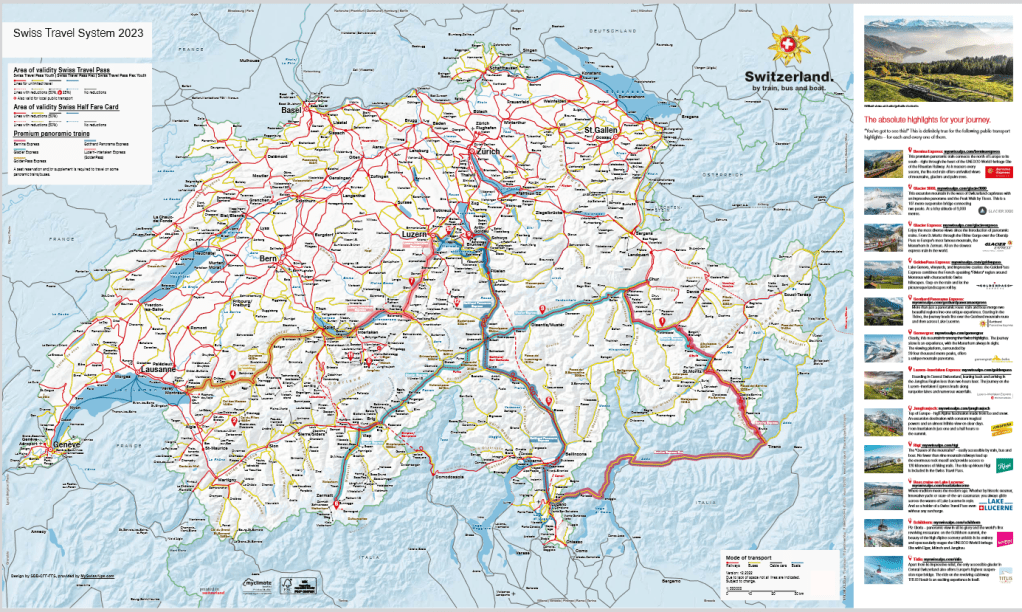
And so which one of these two to choose? The different nuances in their offerings/savings did not lead to an obvious choice. I turned to the internet for help and discovered numerous suggestions, paid advice and even ideas on how to game the system to get the best deal. Yet another suggestion that emerged was a combination of national and regional passes like the Bernese Oberland pass. I attempted a spreadsheet but as a first timer could not access enough information easily. At the end of it all I was thoroughly confused with this information overload and I opted for the Swiss Travel Pass simply for the convenience and the assumption that travel passes are meant to offer savings and sincerely hoped that the Swiss Travel pass would also do so! Thus armed with a Swiss travel pass stored in my phone we spent a very happy time across Switzerland without the hassle of buying a ticket for each trip ( with some exceptions) and hopped on and off trains and trams and boats without a care. See below the map showing area of validity of passes. A very exhaustive and easy to read map –

I had always had this question in mind whether I had selected the right card . It was easy to create a spreadsheet this time around since I was able to now access the info easily with my new found knowledge. And what I found is in the table below. Do note that this is specific to my schedule. While I saved almost 35% off the full fare of 1096 CHF. The savings would have been 26 CHF more had I used a Half fare card. I will put it down as the cost of convenience of a Swiss Travel Pass. I did not need to access a single ticket vending machine during my entire trip. A bit of tweaking the number of days of the validity of the pass would have further increased the savings .
Based on my experience I have a few suggestions to help you select the best card for your. For a start download the SBB app .It has a fund of information for your Spreadsheet. Play around with the number of days validity of the Swiss travel passes and see if the Flexi version suits your plan better. Check out for promos. This year Swiss Travel Pass offered two extra days on a 8 day pass. And compare with a Half fare card. For much longer stays do also look at combination of half fare cards and local or regional cards, But do remember saving money is important but not at the cost of a good holiday!
If any of my readers have any better suggestions please do drop a comment


Are you back
LikeLike
Yes BAck in Hyderabad a few days ago
LikeLike
Informative for all touring Switzerland . Small tips are so useful and make life easy
Thanks Ramanand 👍
LikeLike
[…] Swiss Travel Passes ? A first timer’s dilemma […]
LikeLike
[…] Swiss Travel Passes ? A first timer’s dilemma […]
LikeLike
[…] Swiss Travel Passes ? A first timer’s dilemma […]
LikeLike